
Why NPI requires much more than a new product
Why NPI requires much more than a new product
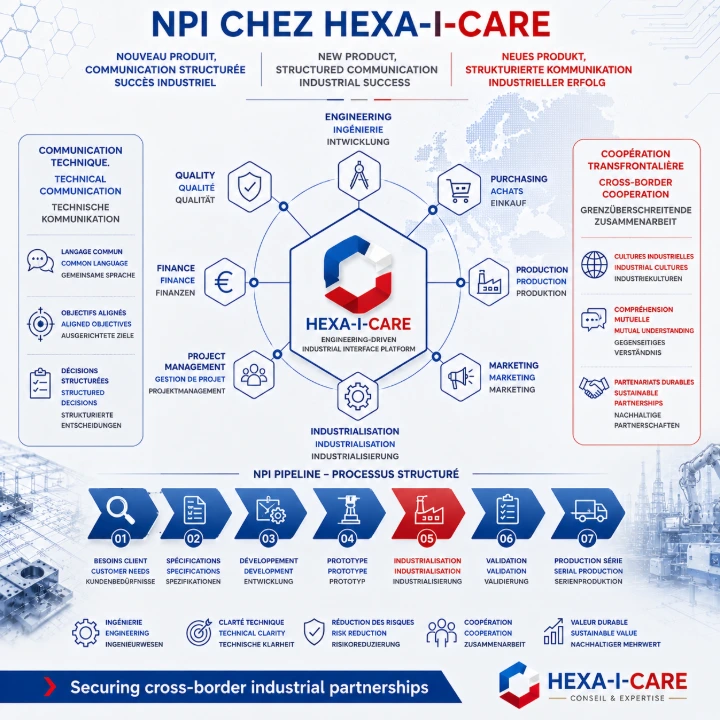
The development of a new product relies primarily on structured communication between professions, companies, and industrial cultures.
Introduction
The launch of a new product (NPI – New Product Introduction) is often perceived as an engineering activity. In reality, it is primarily a cross-functional process where very different functions must work towards a common goal.
Development, quality, industrialisation, purchasing, finance, production, logistics, marketing, and sales each use their own language, their own indicators, and their own priorities.
In an international project, this complexity increases further. In addition to differences in professions, there are differences in language, industrial culture, and national practices.
At Hexa-I-Care, NPI is understood as an industrial coordination process, where technical communication plays a role as important as the technology itself.
NPI is a business project, not just a technical project
A new product only becomes industrial when all functions advance in a coordinated manner.
Among the main actors are:
- Product development
- Industrialisation
- Production
- Quality
- Purchasing
- Supply Chain
- Finance
- Marketing
- Business Development
- Project Management
Each function pursues legitimate but different objectives.
Engineering seeks the best technical solution.
Quality ensures CTQ (Critical to Quality) and risk management.
Purchasing seeks a robust supply chain.
Finance evaluates investments and profitability.
Marketing translates market needs.
Production seeks stable and repeatable processes.
The real challenge is to converge these expectations towards a common decision.
Understanding the language of each profession
In an NPI project, difficulties rarely arise from technology alone.
They often appear when each department uses its own vocabulary.
An engineer talks about tolerances.
Quality talks about capability and process control.
Purchasing talks about costs and suppliers.
Marketing talks about customer value.
Finance talks about return on investment.
All describe the same product, but from different angles.
Creating a common understanding is an essential condition for reducing development risks.
Cross-border projects add a new complexity.
When several countries are involved, a new interface appears.
The differences no longer concern only the professions, but also :
- the languages,
- the communication habits,
- the decision-making methods,
- the industrial practices.
A German manufacturer, a British supplier and a French client can pursue the same goal while using very different approaches.
Linguistic translation is not enough.
It is also necessary to translate technical expectations, industrial constraints and economic objectives.
A structured approach reduces risks
At Hexa-I-Care, NPI is approached as a structured process that gradually connects the different functions of the company.
This approach includes notably :
- clarification of customer needs,
- identification of CTQ,
- consideration of the criteria QCDP (Quality – Cost – Deadline – Performance),
- coordination between functions,
- technical communication,
- tracking of decisions,
- support for industrialisation.
The goal is not only to develop a product.
The goal is to create a product that can be manufactured, industrialised and delivered reliably.
Hexa-I-Care : an industrial interface
Hexa-I-Care does not replace development teams, purchasing, or quality.
Its role is to create an interface between these different actors so that everyone can work with a common understanding.
With over twenty-five years of experience in international industrial environments, Hexa-I-Care facilitates exchanges between professions, companies, and industrial cultures.
This approach helps to reduce misunderstandings, limit development-related risks, and secure cross-border industrial partnerships.
Conclusion
A successful NPI project does not solely depend on good technical design.
It also depends on the ability to effectively collaborate different professions, different companies, and, in many cases, different industrial cultures.
The more structured this communication is, the quicker the decisions are, the more controlled the risks are, and the more robust the industrialisation becomes.
Hexa-I-Care
Hexa-I-Care supports engineering-oriented manufacturers by structuring technical communication, developing industrial projects, and facilitating cross-border cooperation between manufacturers and industrial clients.
Securing cross-border industrial partnerships.