
Why industrial business development requires a structured approach
Why industrial business development requires a structured approach
In many industrial sectors, business development is still presented as a succession of linear steps: initial contact, offer, negotiation, order.
The reality is quite different.
In complex industrial projects, each new piece of information can call into question a decision that has already been made. A change in material, a more demanding tolerance, a change in volumes, or a new customer need can impact design, manufacturing process, cost, timelines, or industrial strategy.
Business development cannot therefore be separated from technical understanding.
The first contact is just the beginning
The first exchange establishes a relationship, but it is not enough to understand the project.
Before any proposal, it is essential to identify:
- the application of the product,
- the technical constraints,
- the client's objectives,
- the quantities,
- the timeline,
- the stakeholders involved in the decision.
This phase conditions the entire project.
Understanding needs before proposing a solution
A relevant offer does not start with a price.
It starts with a precise understanding of needs.
In many projects, the CTQ (Critical to Quality) are the true decision criteria:
- dimensional accuracy,
- repeatability,
- surface condition,
- lifespan,
- assembly behaviour,
- process stability,
- validation requirements.
Without this understanding, it is difficult to demonstrate the value of a technical solution.
An industrial offer is not just about a price
A proposal must meet the client's expectations in terms of QCDP :
- Quality
- Cost
- Deadline
- Performance
These four criteria are closely linked.
A reduction in costs must not compromise quality. An improvement in performance must not call into question deadlines or industrial stability.
The goal is to find a sustainable balance.
Objections often reveal uncertainties
Objections are not just commercial resistances.
They often highlight points that still require clarification:
- technical risks,
- feasibility,
- investments,
- production capacities,
- supply strategy,
- budget constraints.
Addressing them requires a structured approach and dialogue between technical and commercial teams.
Change is part of the project
In an industrial project, requirements frequently evolve.
A change in geometry, material or quantity can influence :
- the tooling,
- the manufacturing process,
- the costs,
- the deadlines,
- the validation,
- the final quality.
Commercial development must therefore integrate genuine change management from the early phases of the project.
A negotiation is prepared
An industrial negotiation is not limited to price.
It must be based on an analysis of the situation, the objectives of each party, the risks, the negotiation margins and the mutual benefits.
A structured preparation allows for the construction of a balanced and sustainable solution.
The role of Hexa-I-Care
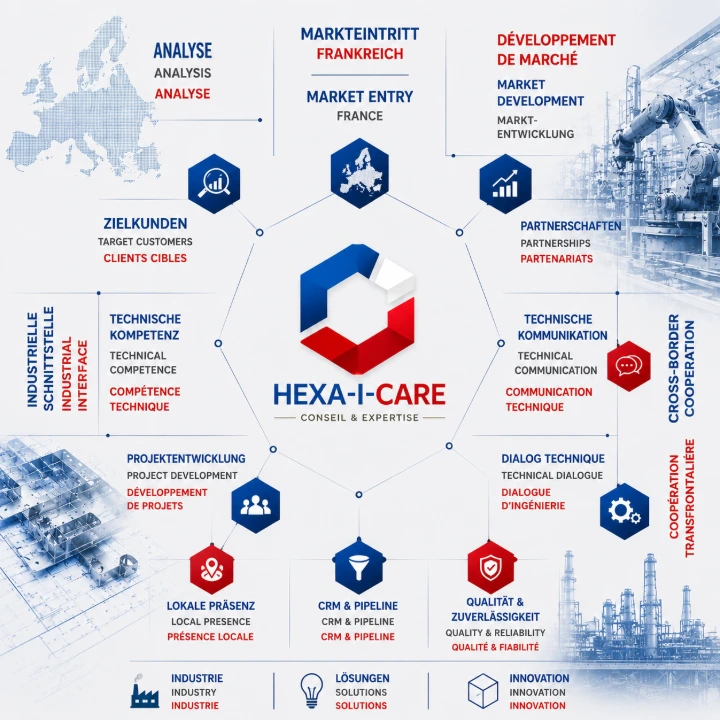
Hexa-I-Care supports manufacturers in developing their markets by creating an interface between customer expectations, technical requirements and industrial objectives.
Our role is not just to create contacts.
We contribute to :
- clarifying needs,
- structuring technical exchanges,
- coordinating the various stakeholders,
- reducing risks,
- supporting projects until the industrial decision.
Because in complex industrial projects, success rarely depends on a single product. It relies above all on a common understanding, structured communication and sustainable cooperation.
Hexa-I-Care — Securing cross-border industrial partnerships.