
Why traditional sales representation sometimes reaches its limits in complex industrial projects
Why traditional sales representation sometimes reaches its limits in complex industrial projects
The evolution of business development in the industry
Sales representation remains an essential model for the development of industrial companies. For decades, it has allowed manufacturers to develop their presence in new markets, establish lasting relationships with their customers, and support their growth.
However, the requirements of industrial projects have profoundly evolved.
In sectors such as mechanics, plastics, precision cutting, electronics, medical devices, or the manufacturing of technical components, projects are no longer won solely through a good commercial offer.
They are gradually built around a technical dialogue, an understanding of industrial needs, and coordination among several stakeholders.
Business development today begins well before the request for quotation.
Industrial projects do not only arise from the purchasing department
For technical products, the purchasing decision generally involves several departments:
- Engineering
- Research and Development
- Industrialisation
- Production
- Quality
- Purchasing
- Project Management
Each stakeholder has their own objectives, constraints, and evaluation criteria.
The real commercial work therefore consists of understanding the technical issues even before presenting an offer.
Selling a solution rather than a product
Industrial clients are primarily looking for a response to a concrete need.
They wish to understand :
- which industrial problem is solved ;
- which risks are reduced ;
- how the solution facilitates industrialisation ;
- what guarantees exist in terms of quality and repeatability ;
- how the supplier supports the project over time.
Technical value thus becomes a determining element of commercial development.
Projects are often won before the call for tenders
In many industries, important decisions are made before the official release of a consultation or an RFQ.
Initial discussions generally focus on :
- technical feasibility ;
- Design for Manufacturing (DFM) ;
- materials ;
- manufacturing processes ;
- quality requirements ;
- prototypes ;
- industrialisation capabilities.
Being present at this stage often allows participation in the project from its conception.
International projects add new requirements
In an international context, difficulties are not solely technical.
Differences in communication, industrial culture, decision-making processes, and work pace can slow down a project that is technically relevant.
A simple translation is therefore not enough.
Manufacturers need a partner capable of ensuring the interface between technical teams, decision-makers, and industrial clients.
Market development is becoming a structured process.
Today, industrial business development relies on several complementary stages:
- Technical onboarding of the manufacturer
- Market and competition analysis
- Identification of target companies
- Identification of technical decision-makers
- Positioning of the value proposition
- Preparation of technical exchanges
- Monitoring of projects and coordination of actions
This approach allows for the gradual construction of a sustainable market presence.
The CRM is becoming a true management tool.
Industrial projects often extend over several months.
It is therefore essential to follow in a structured manner:
- the targeted companies;
- the contacts;
- the technical needs;
- the identified opportunities;
- the price requests;
- the actions taken;
- the next steps.
The CRM is no longer just used to manage business contacts.
It is becoming a true tool for managing market development.
The role of sales representation is evolving.
This does not mean that traditional sales representation is losing its importance.
On the contrary.
Proximity to the market, knowledge of customers, and the relationship of trust remain essential.
On the other hand, expectations are evolving.
Manufacturers are now looking for partners capable of combining :
- business development ;
- technical understanding ;
- project coordination ;
- multilingual communication ;
- CRM follow-up ;
- support for industrialisation.
Commercial representation is thus evolving towards an industrial interface role.
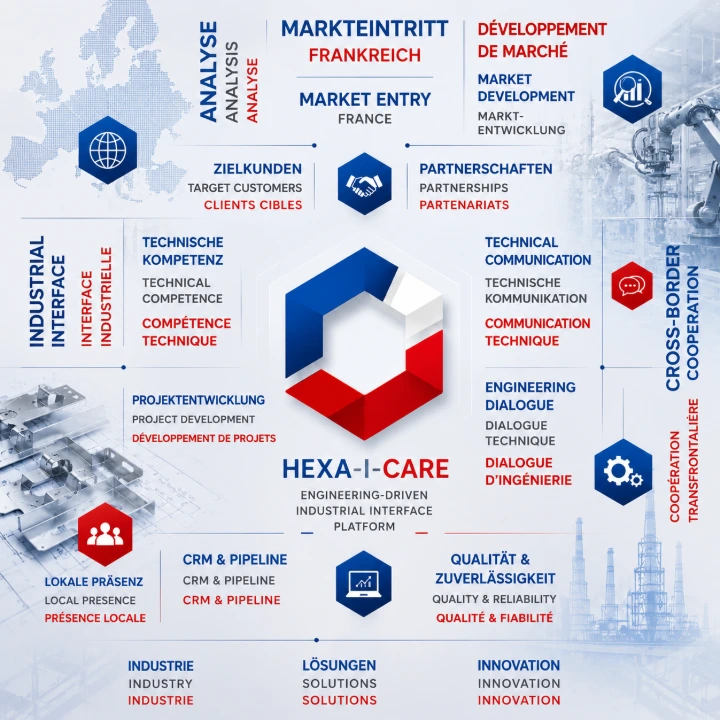
The approach of Hexa-I-Care
Hexa-I-Care is part of this evolution.
Our mission is not that of a classic commercial agency nor a simple intermediary.
We act as Industrial Integrator and engineering-driven industrial interface between manufacturers and their industrial clients.
Our support includes notably :
- market analysis ;
- competitive analysis ;
- technical positioning ;
- identification of companies and decision-makers ;
- technical communication in French, German, and English ;
- structured follow-up of opportunities ;
- coordination of industrial projects ;
- development of sustainable cross-border industrial partnerships.
Conclusion
Industrial projects are becoming increasingly complex.
They require much more than a simple commercial approach.
They demand technical understanding, structured communication, rigorous follow-up, and a genuine ability to link manufacturers and industrial clients.
Commercial representation remains an essential player in industrial development.
It is evolving today towards a broader function, combining market development, technical coordination, and support for international projects.
Hexa-I-Care supports this evolution by securing cross-border industrial partnerships.
Hexa-I-Care — Securing cross-border industrial partnerships.