
Why expertise in manufacturing processes is essential for identifying the right clients
Why expertise in manufacturing processes is essential for identifying the right clients
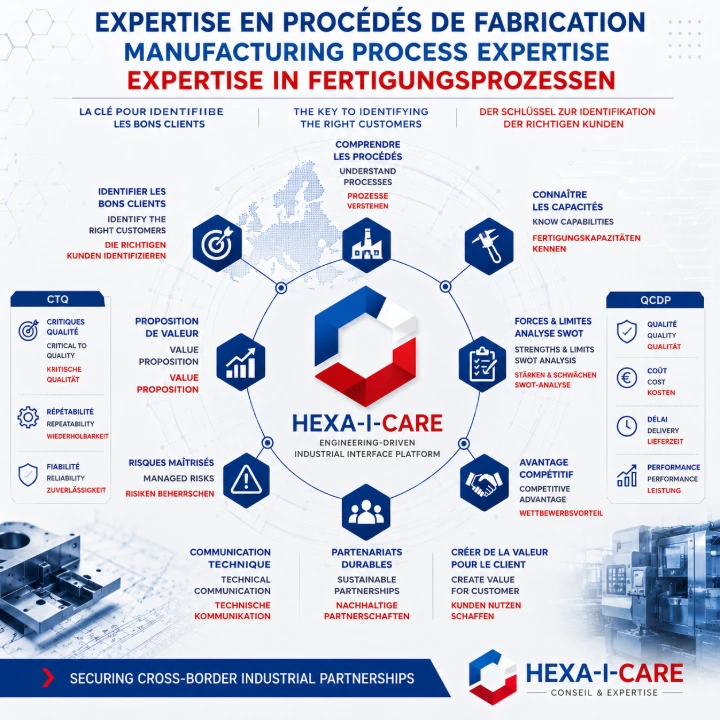
Understanding manufacturing capabilities before developing a market
Industrial business development does not start with a list of prospects. It begins with a deep understanding of the manufacturer's manufacturing capabilities.
In many industrial projects, companies primarily seek to identify new clients. However, this approach often remains ineffective if the technologies, manufacturing limits, and competitive advantages of the manufacturer are not clearly defined.
Targeted prospecting can only be built from a precise knowledge of industrial processes.
Manufacturing processes define the market
Each process has its own possibilities and limitations.
Whether it is plastic injection, precision stamping, CNC machining, die casting, or automated assembly, each technology addresses specific applications.
Before identifying potential clients, it is essential to understand:
- the achievable dimensions,
- the controlled tolerances,
- the compatible materials,
- the production rates,
- the technical constraints,
- the necessary investments,
- the limits of the process.
These elements directly determine the industrial sectors and applications where the manufacturer can truly create value.
Identify the strengths before contacting the market
No manufacturer performs well in all applications.
Each company has areas where it brings real added value.
A structured analysis of the type SWOT allows for the identification of :
Strengths
The technical advantages :
- process control,
- repeatable quality,
- specific know-how,
- automation,
- expertise in industrialisation.
Weaknesses
The areas where capabilities are limited :
- uncontrolled materials,
- low volumes,
- maximum dimensions,
- absent technologies,
- industrial dependencies.
Opportunities
The markets where existing skills meet real demand.
Threats
Competition, technological developments or market changes that may reduce competitiveness.
This analysis helps to direct commercial efforts towards projects where the chances of success are highest.
Define a credible value proposition
In a highly competitive industrial environment, it is no longer enough to claim that one offers better quality.
The customer wants to understand why one supplier is more relevant than another.
An effective value proposition answers concrete questions:
- What industrial problem is being solved?
- What risks are being reduced?
- What criteria CTQ (Critical to Quality) are secured?
- How does the solution improve the criteria QCDP (Quality – Cost – Deadline – Performance) ?
- Why is this technology more suitable than existing alternatives?
The answer to these questions relies on a deep understanding of the manufacturing process.
Choosing the right clients rather than all clients
Effective prospecting is less about contacting a large number of companies than about identifying those that have a real technical compatibility.
This selection is based on several criteria:
- technologies used,
- industrial applications,
- quality requirements,
- production constraints,
- level of innovation,
- partnership potential.
By focusing efforts on companies that truly match the manufacturer's capabilities, interactions become more relevant and productive.
This approach also avoids unnecessarily mobilising the time of sales teams as well as that of clients.
Technical communication as a differentiating factor
Once the right clients are identified, communication plays a crucial role.
The goal is not to present a product catalogue, but to clearly explain:
- the capabilities of the process,
- the technical limits,
- the industrial benefits,
- the risks avoided,
- the applications for which the manufacturer provides real value.
This communication establishes a relationship of trust from the very first technical discussions.
The role of Hexa-I-Care
Hexa-I-Care supports manufacturers by analysing their manufacturing processes, their industrial skills, and their technical positioning before any commercial approach.
This understanding allows for the identification of sectors, applications, and clients with the best potential, while building a value proposition consistent with the actual capabilities of the industrial partner.
Commercial development thus becomes a structured approach, based on engineering, understanding of processes, and the creation of sustainable industrial partnerships.
Hexa-I-Care – Securing cross-border industrial partnerships.Start writing here...