
Too much information does not replace structure
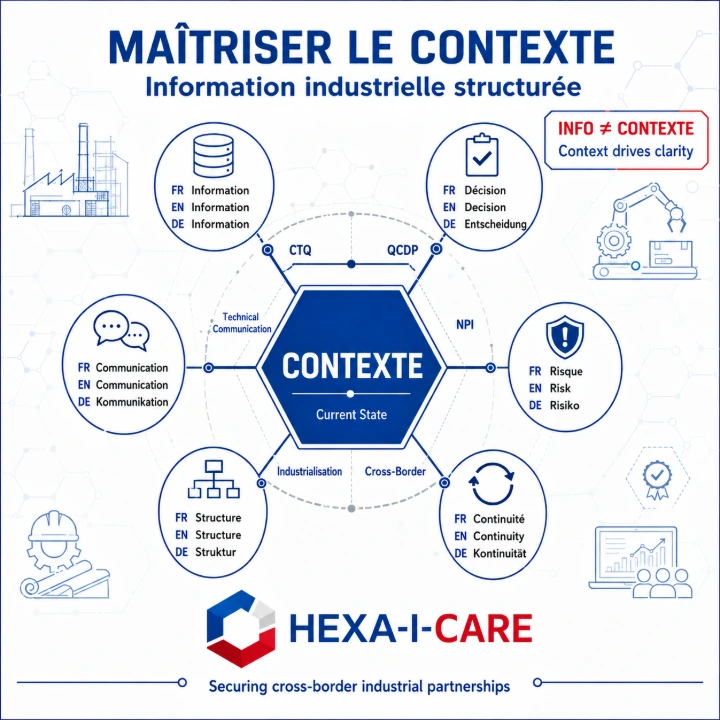
Too much information does not replace structure
Why mastering context becomes essential in industrial projects
Industrial companies today have more information than ever: emails, meeting minutes, technical specifications, offers, customer histories, project changes or internal decisions.
The problem is therefore no longer primarily about collecting information.
The real challenge is to determine which information is relevant, which is still valid, and what decision should follow from it.
In international industrial projects, this distinction becomes particularly important. Technically correct information can become outdated. An old customer requirement may have been replaced. A project assumption may continue to appear in documents even though it is no longer valid.
The quantity of information does not guarantee the quality of the decision.
Information without context creates a risk
With current digital tools, it becomes easy to centralise several years of documents and communications.
One might think that it is then enough to search for the necessary information to automatically find the right answer.
In an industrial environment, this reasoning quickly reaches its limits.
A report dating back six months can remain perfectly accurate while no longer representing the current situation. Two versions of a specification can coexist. A volume estimate may have been replaced by a new assumption.
All this information can be "true" in its historical context.
However, they are not equivalent.
The important question is therefore no longer solely:
"What information do we have?"
but rather:
"What information is currently relevant?"
This difference is essential for the quality of technical, commercial, and industrial decisions.
Structuring information before using it
An effective system must allow for a clear distinction between several levels of information:
- the current situation of the project;
- the validated decisions;
- the historical information;
- the reference technical data;
- the still open assumptions;
- the responsibilities and points requiring action.
This distinction reduces the risk of using correct information that has become obsolete.
It becomes particularly important when a project involves several departments: engineering, quality, purchasing, production, finance, or management.
Each function observes the same project from a different angle.
A structured technical communication allows for a common understanding of the CTQ — Critical to Quality, objectives QCDP — Quality, Cost, Delivery, Performance, industrialisation constraints and decisions made.
The objective is not to produce more documentation.
The objective is to create a common reference that is clear enough to enable decision-making.
Communication is also an industrial risk
In a complex project, poor information does not only cause an administrative problem.
It can influence a technical decision, a supplier consultation, a capacity estimate or a client discussion.
A simple misunderstood status change can alter all communication.
A project still in the prototype phase can, for example, be presented a few weeks later as a future series project when no such decision has been made.
This difference may seem minor.
For the client, it can however show that their project has not been properly understood.
In cross-border industrial relations, the risk increases further.
In addition to technical differences, there are languages, communication habits, internal organisations and sometimes different interpretations of responsibilities.
The mastery of information then becomes directly linked to the security of communication.
A clear structure also accelerates decisions
Structuring information does not mean slowing down organisations.
It is often the opposite.
When a project manager, an engineer or a buyer can quickly understand:
- the context ;
- the current situation ;
- the latest decisions ;
- the main constraints ;
- the points still open ;
it can intervene more quickly and with less uncertainty.
Speed does not necessarily come from an immediate response.
In the industry, it mainly comes from the ability to obtain quickly a reliable response.
Less research, fewer ambiguities and less reconstruction of the context allow for more effective decision-making.
Continuity becomes strategic
Industrial projects can last several months, sometimes several years.
The stakeholders change. Responsibilities evolve. Specifications are modified. New technical constraints arise.
Without structure, a significant part of the knowledge remains attached to individuals.
When a collaborator leaves a project or when a new manager arrives, a large part of the context must then be rebuilt.
A structured organisation, on the contrary, allows for the preservation of continuity.
It must allow for a quick understanding of :
what has been decided, what has changed, what is still valid and what remains to be clarified.
This continuity reduces dependence on individuals and stabilises cooperation between clients, suppliers and technical teams.
Technology does not replace industrial discipline
Digital tools can accelerate research, analysis and access to information.
But they do not automatically decide which information constitutes the operational reference.
This responsibility remains linked to the quality of processes.
The more data companies have, the more they must be able to control their context.
The principle can ultimately be summarised simply:
The difficulty is no longer just accessing information. It is about mastering its context.
For international industrial projects, this mastery improves the quality of communication, reduces the risks of misinterpretation, and facilitates more structured decisions.
Conclusion
Effective management of industrial information is not about accumulating more and more data.
It is about making visible what is relevant, current, and decision-making.
A structured approach allows for:
- reducing ambiguities;
- securing technical communication;
- accelerating project understanding;
- improving continuity;
- facilitating decisions between engineering, purchasing, quality, and management.
In an increasingly complex industrial environment, structure thus becomes a condition of reliability.
Hexa-I-Care
Hexa-I-Care acts as Industrial Integrator and Engineering Interface to structure technical communication, the development of industrial projects, and cooperation between engineering-driven manufacturers and industrial clients in France and Europe.
The objective is to strengthen technical clarity, project continuity, and the reliability of cross-border industrial relations.
Securing cross-border industrial partnerships.