
Structured NPI / NPD milestones for cross-border industrial partnerships
Structuring deliverables to build sustainable industrial cooperation
Cross-border industrial partnerships require more than an initial business contact. When technical products, tooling, precision parts, plastic components, or manufacturing processes are involved, cooperation must be structured from the outset.
In an international project, the client, supplier, engineering, quality, purchasing, logistics, and production teams do not always have the same priorities. Without a NPI / NPD clear process, expectations can remain misaligned and become project risks.
A structured NPI / NPD process allows for the definition of:
- the project milestones;
- the expected deliverables;
- the responsibilities;
- the open points;
- the necessary decisions;
- the technical, quality, cost, and time risks.
This logic aligns with the fundamental principle of an industrial process: transforming an initial situation into a controlled outcome through a structured framework, feedback, and continuous regulation. In an NPD project, the milestones and deliverables serve precisely to control maturity before moving to the next stage.
Why clarify early?
In an industrial project, costs increase over time while the ability to modify decreases. It is therefore essential to address as many critical issues as possible from the early phases: technical requirements, manufacturing constraints, quality, logistics, validation, costs and planning.
A late clarification can lead to tooling changes, validation delays, estimation errors or instability in production.
The goal is not to create bureaucracy, but to reduce uncertainty before the project becomes costly and difficult to modify.
An NPI / NPD pipeline suitable for international use
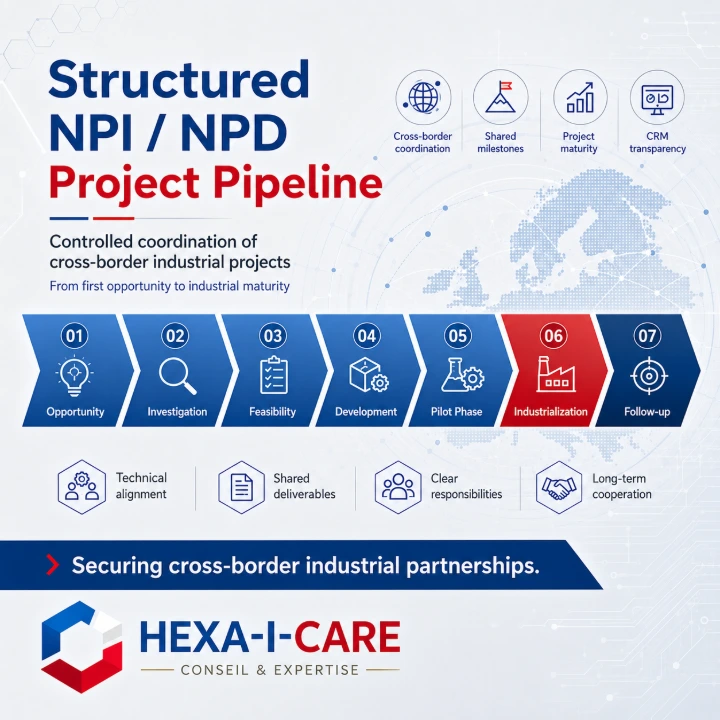
A cross-border industrial project can be structured around several stages:
1. Opportunity
Understand the customer need, the application context and the strategic interest of the project.
2. Investigation
Analyse alternatives, market references, technical constraints and open points.
3. Feasibility
Check if the product can be manufactured with the expected costs, deadlines, tolerances and quality requirements.
4. Development
Coordinate plans, samples, specifications, offers, validations and customer feedback.
5. Pilot phase
Test the product and the process under conditions close to series production.
6. Industrialisation
Stabilise the tooling, process, quality documentation, logistics and commercial conditions.
7. Monitoring
Compare the objectives to the actual result: costs, quality, volumes, customer satisfaction and cooperation performance.
This pipeline allows for checking the project's maturity at each milestone and deciding whether to continue, adapt, postpone or stop the project.
Deliverables as a common language
In cross-border industrial partnerships, deliverables create a common language between the client and the partner.
They define what needs to be available, when, by whom, and for what decision. Without clearly defined deliverables, costs, scheduling and the robustness of the project become difficult to manage.
Clear deliverables reduce:
- misunderstandings;
- rework;
- late changes;
- validation delays;
- communication errors;
- tensions between client and supplier.
Hexa-I-Care as an industrial interface
Hexa-I-Care supports cross-border industrial projects by acting as an engineering-oriented industrial interface between manufacturers, suppliers and industrial clients.
Our role is to clarify expectations, structure milestones, track open points, facilitate technical communication and support stable cooperation over time.
In an international environment, a good NPI/NPD process is not only used to develop a product. It is also used to build a reliable industrial relationship.
Hexa-I-Care — Securing cross-border industrial partnerships.