
Industrial CRM and AI
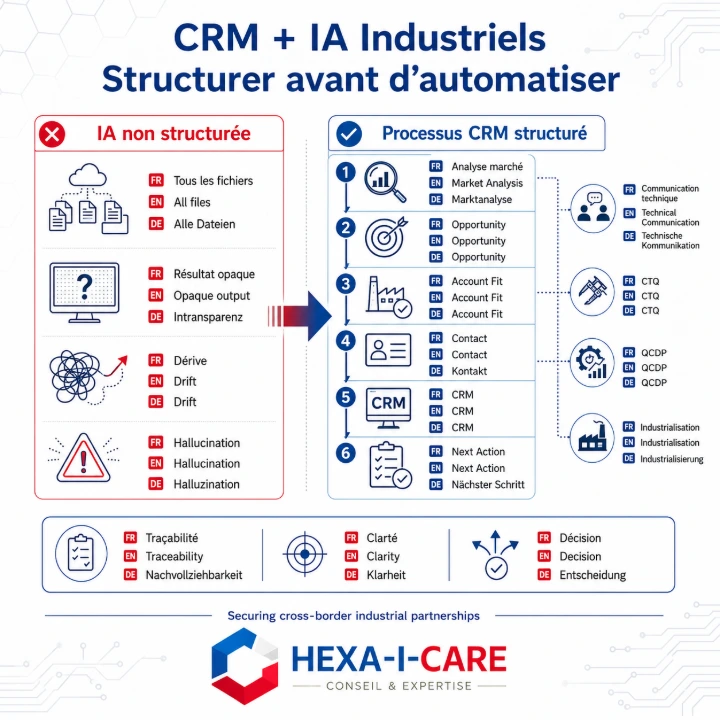
Industrial CRM and AI: structure before automating
Why the quality of an AI primarily depends on the information architecture
Artificial intelligence is quickly entering CRMs. But two very different approaches are possible.
The first involves giving the AI access to as much data as possible: emails, notes, contacts, reports, opportunities, documents, and business history. The AI analyses everything and generates a recommendation.
This approach can be quick. But an immediate question arises:
How did the AI arrive at this conclusion?
In industrial development, this lack of traceability can become problematic. Market information can be interpreted as a customer need, a supplier capability as a project requirement, or an old conversation as a current opportunity.
The more abundant and unstructured the information, the greater the risk of drift, misattribution, or hallucination increases.
Another approach: integrate the AI into the process
Hexa-I-Care uses a different logic.
The goal is not to ask the AI to "understand everything." It is primarily about structuring the industrial and commercial process, then providing the AI only with the context necessary for each decision.
The chain can for example follow this logic:
Partner Knowledge → Market Analysis → Opportunity → Account Fit → Contact → CRM → Next Action
Each step answers a specific question.
Market Analysis
Why is this market relevant?
Opportunity
Which application or industrial interface deserves to be studied?
Account Fit
Why might this company match the partner's capabilities?
Contact
Is this contact technically or commercially relevant?
CRM
What actually happened?
Next Action
What is now the most logical action?
AI intervenes within this structure, not in its place.
Reduce drift by separating information
This architecture allows for an essential distinction between:
facts → hypotheses → qualification → action
Market growth does not automatically become a customer opportunity.
An Account Fit does not automatically become an RFQ.
A technical contact does not automatically become a decision-maker.
And an industrial capability should never artificially become a customer requirement.
This separation seems simple, but it profoundly changes the quality of an AI-assisted CRM system.
It also allows for understanding where a recommendation comes from and returning to the information that triggered it.
The CRM becomes a decision support tool.
In this logic, a CRM task is no longer limited to :
Follow-up.
It can become :
NEXT ACTION
Identify another technical contact.
OBJECTIVE
Clarify the responsibility for the relevant component family.
WHY NOW
Previous exchanges have not yet allowed for the identification of the right technical owner.
AI then helps to transform already structured information into operational clarity.
Judgment remains human. Traceability remains visible.
The Hexa-I-Care approach
Hexa-I-Care develops this architecture around the realities of industrial business development: manufacturing capabilities, markets, Account Fit, technical communication, qualification of contacts, CTQ, projects and CRM follow-up.
The challenge is not to add AI to a CRM.
It is to build a system where AI has the right context, at the right time, for the right decision.
For engineering-driven manufacturers developing new markets in France and Europe, this approach allows for better structuring of information, limiting drift and preserving continuity between market analysis and commercial execution.
Securing cross-border industrial partnerships.