
Entering the French industrial market: the challenge for German companies
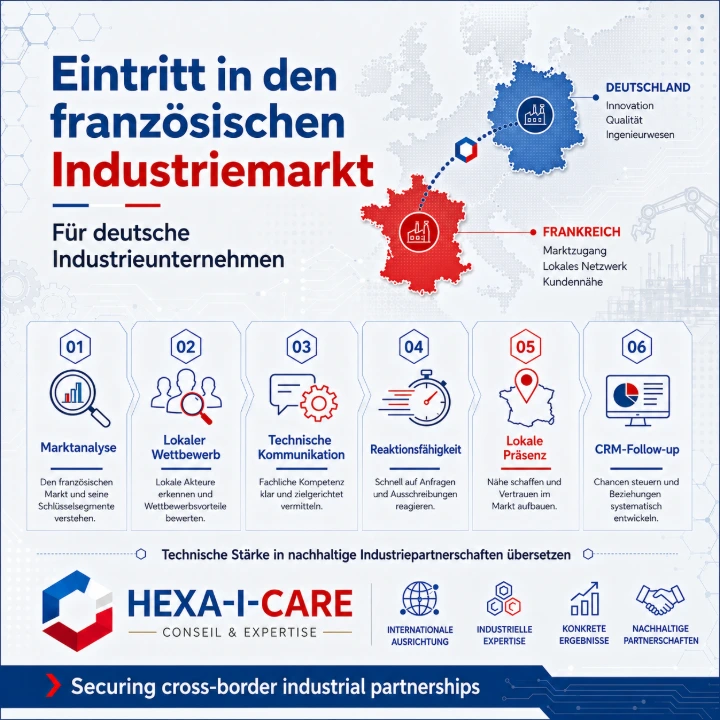
For many German industrial manufacturers, France represents a nearby, attractive, and strategically important market. European standards, geographical proximity, and industrial complementarities create real opportunities.
But in practice, entering the French market is not just about translating a brochure, attending a trade fair, or contacting a few buyers.
Technical quality is essential, but it is not enough.
A new article published on OSF analyses the key success factors for German industrial companies wishing to sustainably develop their presence in France:
France is not an empty market
A common mistake is to consider France as a market that is naturally accessible for a German industrial company.
However, in many sectors, French customers are already working with established suppliers, local industrial SMEs, regional networks, and trusted technical partners.
These competitors are not always larger, but they are often close to the customer, responsive, and well integrated into the local industrial environment.
A German manufacturer may therefore have an excellent technical solution and still lose an opportunity if their offer is not sufficiently clear, quick, or adapted to the local context.
Technical communication is crucial
In the industry, sales are not limited to a business discussion.
It is necessary to clarify the plans, the tolerances, the materials, the manufacturing processes, the quality requirements, the prototypes, the validation and the conditions for series production.
The real question is therefore not just:
Who could buy this product?
But rather:
What industrial problem can this manufacturer reliably solve?
This approach requires a dialogue with purchasing, but also with the engineering, quality, industrialisation, production and supplier development teams.
Understanding the differences in operation
German companies often work with very structured processes, a strong documentary culture and a factual approach.
In France, some decisions may depend more on direct relationships, responsiveness, the local situation and individual initiative at the site or business unit level.
This is not an opposition between rigor and improvisation. It is a difference in the way trust is built, urgency is handled, and projects are advanced.
A good market development must therefore connect German industrial discipline with the responsiveness and customer proximity expected in the French market.
The price must be linked to industrial value
French customers can be price sensitive. This does not mean they are bad customers or that they are only looking for the cheapest supplier.
The question is to make the real industrial value visible:
process stability, reduction of quality risks, better repeatability, reduction of waste, tool life, delivery reliability, technical support and securing industrialisation.
The objective is not to enter into a price war, but to clearly demonstrate the relationship between price, technical performance, risk reduction and long-term value.
Large groups do not always operate in a centralised manner.
Another important point concerns the organisation of large industrial groups.
A contact at headquarters does not automatically provide access to all factories or business units. In many cases, supplier and project decisions are made at the local level.
This means that market development in France requires a more structured approach:
site analysis, identification of the right contacts, project follow-up, CRM reminders, adaptation of the technical message and gradual construction of internal references.
This work takes time, but it also creates solid opportunities when a first site becomes a reference for other entities within the same group.
The role of Hexa-I-Care
Hexa-I-Care supports engineering-oriented industrial manufacturers in their development in the French market.
Our role is to act as an industrial interface between manufacturers and clients:
analyse the market, identify the right contacts, clarify technical needs, structure CRM follow-up, interpret price reactions, support intercultural communication and build sustainable industrial partnerships.
Hexa-I-Care is not a generic commercial agency nor a sourcing intermediary.
We work as a technical, commercial and operational interface to secure cross-border industrial cooperations.
Conclusion
Successfully entering the French market does not solely depend on the quality of a product.
It requires an understanding of the local market, clear technical communication, good responsiveness, a realistic analysis of the competition, a local presence, and structured follow-up over time.
The development of the French market is therefore less a one-off commercial action than a structured process of building industrial partnerships.
Hexa-I-Care — Securing cross-border industrial partnerships.